
Thumb Joint Replacement: A New Alternative for Patients with Advanced Thumb Arthritis
June 25, 2026
Reviewed by: Mohab Foad, M.D.
KEY TAKEAWAYS
- Thumb CMC joint replacement treats advanced arthritis at the base of the thumb by replacing the worn joint with a small implant instead of removing bone.
- Trapeziectomy removes the trapezium bone and rebuilds thumb support from surrounding soft tissue. Joint replacement keeps the bone and resurfaces the joint.
- The best candidates have arthritis limited to the base of the thumb and enough healthy bone to hold the implant.
- Recovery runs 2 to 4 weeks in a splint, with grip-heavy activity returning around 8 to 12 weeks.
- If an implant fails, a surgeon can usually convert to a traditional trapeziectomy.
- Dr. Mohab Foad offers thumb CMC joint replacement at Beacon Orthopaedics locations across Cincinnati and Northern Kentucky.
Thumb CMC joint replacement is a surgical procedure that treats advanced arthritis at the base of the thumb. A surgeon removes the worn joint surfaces and implants a small metal cup and ball-and-stem system that works like a miniature hip replacement. The implant restores a stable, mobile joint and preserves thumb motion.
For many people, arthritis at the base of the thumb can turn everyday activities into painful challenges. Opening jars, turning keys, gripping a golf club, or even holding a coffee mug can become increasingly difficult as the joint wears down over time.
Now, patients suffering from advanced thumb arthritis may have a new treatment option at Beacon Orthopaedics & Sports Medicine. Hand surgeon Dr. Mohab Foad is among the first physicians in the region offering thumb carpometacarpal (CMC) joint replacement, an innovative procedure designed to relieve pain while preserving motion and function, to patients across Cincinnati and Northern Kentucky.
What Is Thumb CMC Arthritis?
The thumb CMC joint is located where the thumb meets the wrist(opens in new tab). While small, it plays a critical role in nearly everything we do with our hands.
“The 1st CMC joint allows your thumb to oppose against your fingers, pinch and grip objects, and perform the movements that make the human hand unique,” says Dr. Foad. “When arthritis develops in that joint, patients can lose strength, function, and quality of life.”
Thumb arthritis is one of the most common conditions treated by hand surgeons(opens in new tab). While injuries can contribute, the condition is most often caused by natural age-related wear and tear and genetics.
As cartilage wears away, bone begins rubbing against bone, leading to pain, weakness, inflammation, and difficulty performing routine tasks.
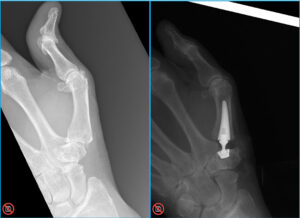
Thumb Joint Replacement vs. Trapeziectomy
For decades, the standard surgical treatment for advanced thumb arthritis has been a procedure called a trapeziectomy, often combined with a ligament reconstruction or suspension procedure.
During surgery, the trapezium—a small wrist bone that forms part of the arthritic joint—is removed. The thumb is then stabilized using surrounding soft tissues to maintain function and reduce pain.
The procedure has an excellent track record and remains the most commonly performed surgery for thumb arthritis.
“Traditional thumb arthritis surgery has helped patients for decades and remains an excellent option,” says Dr. Foad.
Most patients experience significant pain relief and improved function following recovery. However, rehabilitation can take time.
“Our goal isn’t to give patients the thumb they had in their twenties,” Dr. Foad explains. “It’s to give them a thumb that lets them live without the pain that’s limiting them today.”
Recovery from traditional surgery often requires several months before patients begin feeling substantial improvement, with strength and function continuing to improve for up to a year.
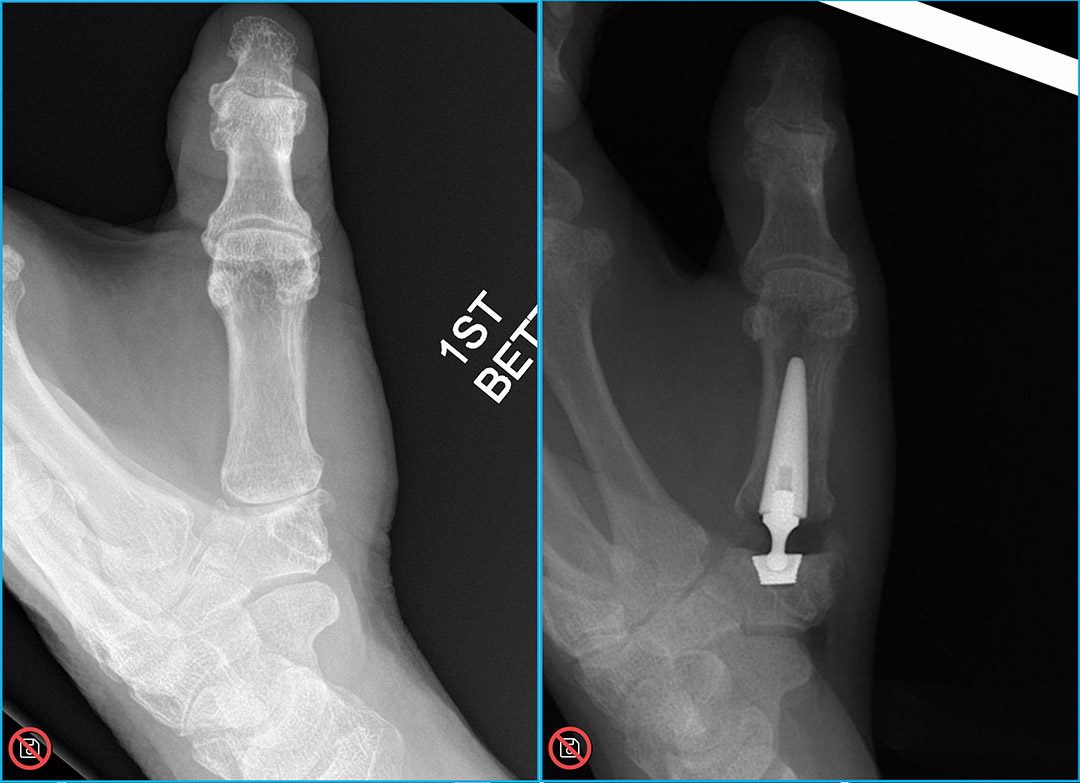
How the CMC Implant Works
Thumb joint replacement takes a fundamentally different approach.
Instead of removing the arthritic joint, surgeons replace it with a specialized implant system that functions similarly to a miniature hip replacement.
A small metal cup is placed into the trapezium, while a stem and ball component are inserted into the thumb metacarpal. The components work together to create a stable, mobile joint designed to mimic natural thumb movement.
“This procedure represents a completely different philosophy,” says Dr. Foad. “Rather than removing the arthritic joint, we’re restoring it with a replacement designed to preserve motion and function.”
While thumb joint replacement has been utilized in Europe for years(opens in new tab), newer implant designs have addressed many of the challenges seen with earlier generations of devices. Current studies have demonstrated promising outcomes, including improved patient satisfaction, maintained range of motion, and durable results.
Who Is a Candidate for Thumb Joint Replacement?
Not every patient with thumb arthritis is a candidate for joint replacement.
The best candidates typically have arthritis isolated to the base of the thumb and enough healthy bone to support the implant. Patients with severe bone loss, arthritis involving neighboring joints, prior infections, or previous thumb arthritis surgery may be better served by alternative procedures.
What happens if the implant fails?
One advantage of thumb joint replacement is that if the implant eventually fails, surgeons can often still perform a traditional trapeziectomy as a revision procedure.
“Every patient is different,” says Dr. Foad. “The more treatment options we have, the better we can tailor a solution to the individual sitting in front of us.”
Dr. Foad sees thumb arthritis patients at Beacon’s Summit Woods location in Sharonville and at Beacon East, and he holds privileges at most area hospitals.
Recovery Timeline and Return to Activity
One of the most promising aspects of thumb joint replacement may be recovery time.
Traditional thumb arthritis surgery often requires months before patients feel they have truly turned the corner. Early experiences with thumb replacement suggest that many patients regain comfort and function much sooner.
While long-term U.S. data continues to develop, surgeons around the country are reporting encouraging early outcomes, with some patients returning to activities significantly faster than expected following traditional reconstruction procedures.
Finding a Hand Surgeon in Cincinnati
Beacon Orthopaedics treats hand and wrist conditions at more than 20 locations across Greater Cincinnati, Northern Kentucky, and the Dayton area.
Thumb joint replacement is not intended to replace traditional thumb arthritis surgery. Rather, it offers another option for carefully selected patients seeking pain relief and restored function.
For many patients, trapeziectomy will continue to be the right choice. But for others, particularly those interested in preserving more natural thumb mechanics and potentially shortening recovery, joint replacement may provide meaningful advantages.
“For the right patient, thumb joint replacement has the potential to restore comfort, preserve motion, and help people return to the activities they love sooner,” says Dr. Foad.
If thumb arthritis is interfering with your daily life, the hand specialists at Beacon Orthopaedics & Sports Medicine can help determine which treatment approach is right for you.
Thumb Joint Replacement FAQs
Is thumb joint replacement an outpatient procedure?
Yes. Thumb CMC joint replacement is performed on an outpatient basis, usually at a Beacon surgery center. Most patients go home the same day, often within a few hours of surgery. The procedure is done under regional or general anesthesia depending on what you and your surgeon decide together.
How long does a thumb implant last?
Implant survival depends on the design used and on patient factors like bone quality and activity level. Long-term European studies of modern implants report survival rates around 90 percent at ten years. Your surgeon will review what the data shows for the specific implant recommended for you.
Does insurance cover thumb joint replacement?
Coverage varies by plan and by the specific implant. Most major insurers cover surgical treatment for advanced thumb arthritis when conservative care has not worked. Beacon’s team can verify your benefits and explain your expected costs before you schedule. Call (513) 354-3700 to start that review.
When can I drive after thumb joint replacement?
Most patients return to driving around 4 to 6 weeks, once the splint comes off and you can grip the wheel comfortably without pain medication. Driving with a thumb splint is not safe for most people. Your surgeon will clear you at a follow-up visit based on how your grip and comfort are progressing.
Can I have joint replacement if I’ve already had thumb surgery?
Prior thumb arthritis surgery makes joint replacement more difficult, and in many cases it rules the procedure out. The implant needs enough healthy trapezium bone to seat into. If you’ve had a previous trapeziectomy or reconstruction, Dr. Foad will review your imaging and discuss which options remain open to you.

About Dr. Mohab Foad
Mohab Foad, M.D., is a board-certified orthopaedic surgeon at Beacon Orthopaedics & Sports Medicine specializing in hand and upper extremity care. He completed his medical training and orthopaedic residency at the University of Cincinnati College of Medicine, followed by a hand and microsurgery fellowship at the Indiana Hand Center. He holds a Certificate of Added Qualification in surgery of the hand and remains on the teaching faculty at the University of Cincinnati. Dr. Foad sees patients at Beacon’s Summit Woods location in Sharonville and at Beacon East.